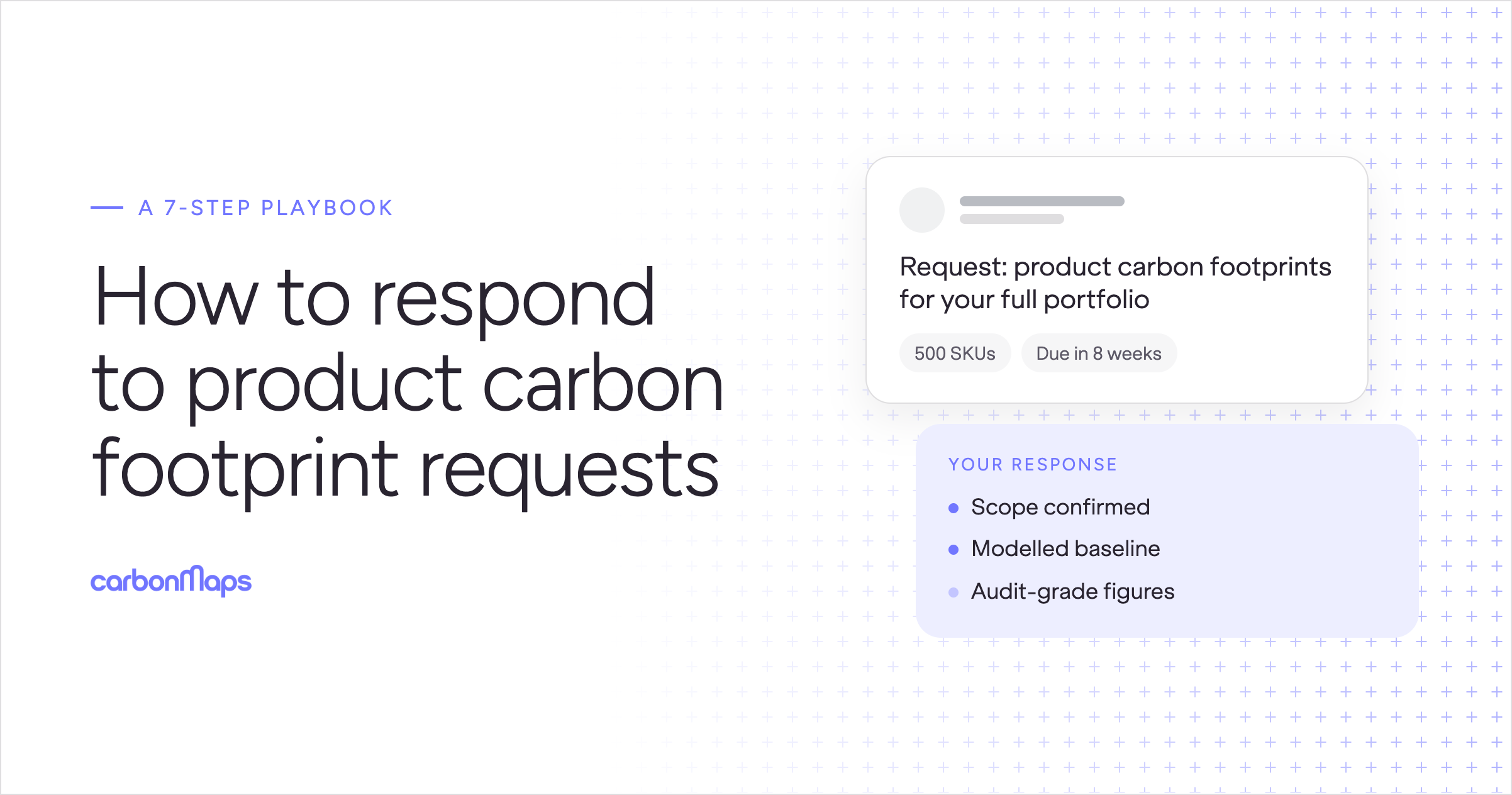



An email lands from one of your largest retail customers. They need product carbon footprints across your portfolio, in their template, by a date that feels weeks too soon. The account is important, the deadline is real, and the data you would need is scattered across recipes, specs and supplier records you have never had to assemble this way before.
If that scenario is familiar, you are not behind. This kind of product carbon footprint (PCF) request has moved in the last two years from an occasional courtesy to a supplier-selection criterion, and it is arriving faster and at larger scale. One ingredients manufacturer was recently asked for footprints on roughly 500 products by year-end. A fruit-preparation maker was given about two months by a major grocer. The instinct is either to promise everything and scramble, or to send back rough numbers to buy goodwill. Both create problems later, especially now that unsubstantiated environmental claims carry legal exposure across the EU.
There is a better way to handle it. The following seven steps are a practical guide on to how to answer credibly and fast, protect the relationship, and avoid committing to numbers you cannot stand behind.
Before you promise anything, pin down the request. Most panic comes from an ask that was never fully defined, not from a genuine inability to deliver. One distributor confirmed it had everything it needed from a vendor on price and capability; the real hold-up was that no one had clarified what the retailer actually wanted.
Send a short set of scoping questions back within a day or two:
The "why" matters as much as the "what." A figure feeding an internal hotspot screen needs far less rigour than one that will appear on a public label, where it must survive scrutiny and comparison.
A fast acknowledgement is not the same as a fast full data set, and conflating the two is where credibility gets lost. Reply quickly, but reply with a staged plan rather than a blanket "yes."
A phased response works better than a single deadline:
This lets you move at the retailer's pace on the parts that can move fast, while protecting the parts that cannot be rushed.
Be explicit about the difference between "what we can show you in three weeks" and "what is defensible in three months." The distributor that asked its retailer for more time and staged the build kept the relationship intact; the risk you are avoiding is a timeline that forces either a missed deadline or unreliable numbers.
Start with the SKUs the retailer named explicitly. Then rank the rest by the volume you sell to that retailer, since those products weigh most in its Scope 3.1. Finally, flag ingredient-heavy products such as dairy, meat or cocoa, where the agricultural stage dominates the footprint and a modelled figure is most likely to move once primary data comes in.
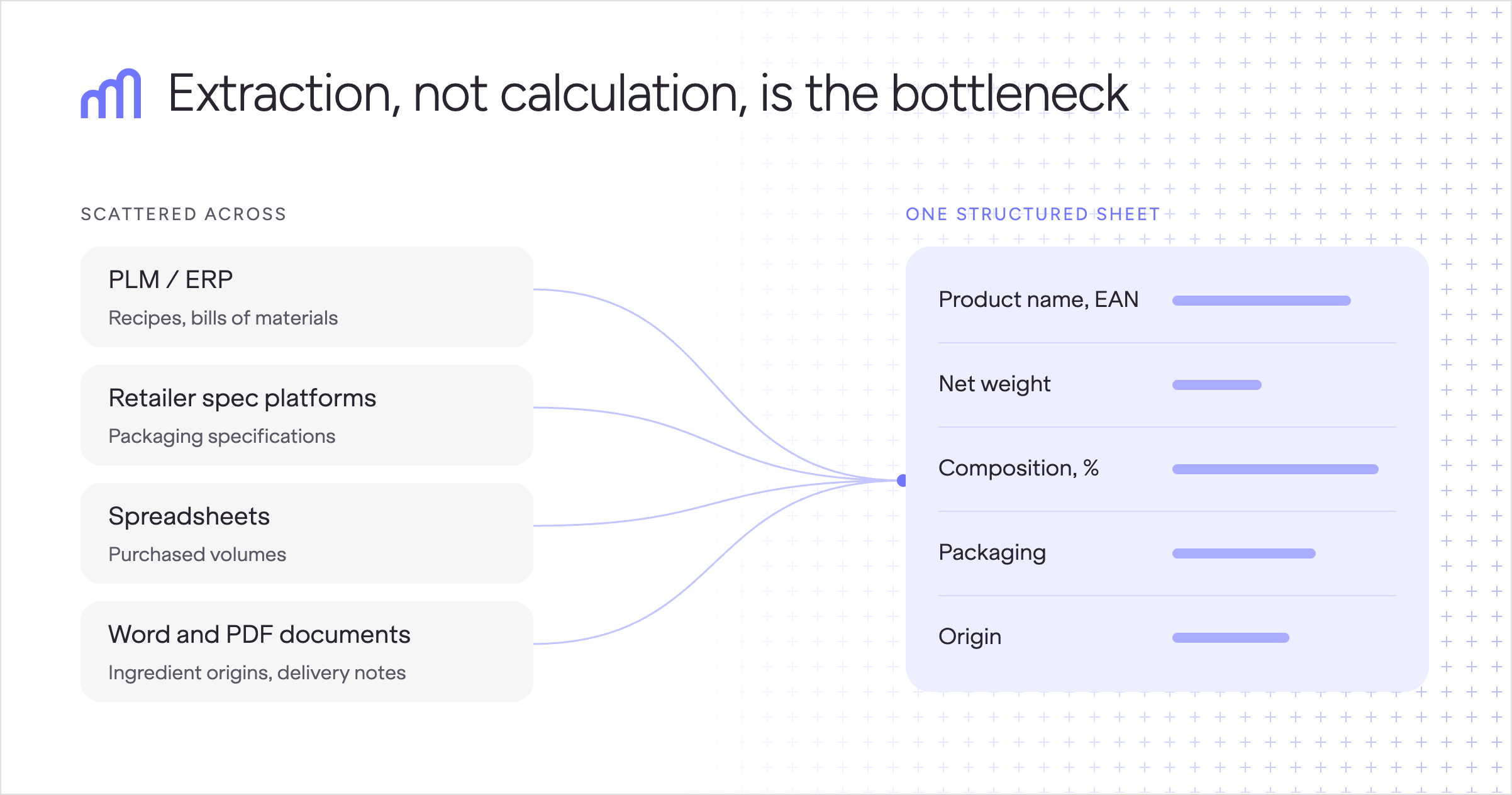
Data extraction, not calculation, is almost always the real bottleneck, so scope it before you model anything. You will need recipes or bills of materials, packaging specifications, ingredient origins and purchased volumes, and in most food businesses these live in different places at once.
That fragmentation is normal. One distributor held no central master database at all, because it fed data straight into its retailers' third-party spec platforms. A premium grocery retailer had product specs still migrating out of Word documents. In practice the data sits across a PLM or ERP, retailer spec platforms, and spreadsheets.
Sometimes it barely exists as data at all. A world-renowned luxury hotel wanted an ingredient-by-ingredient view of its food footprint, but every purchase sat in thousands of PDF delivery notes spread across its restaurants, bars, pâtisserie and banquets. With no central view, reliable measurement was impossible. Carbon Maps ran the PDFs through its generative AI extraction engine and rebuilt the hotel's procurement dataset in hours, covering 772 tonnes of food purchases.
Read the full case study: How a Luxury Hotel Uses Carbon Maps to Measure the Environmental Impact of its Procurement
Two concrete moves save weeks here. First, nominate a single data owner to run the extraction as a defined task rather than a background favour. Then consolidate everything into one structured sheet with the fields a calculation actually requires:
Do not wait for perfect supplier data to produce a first answer. Score your priority products from a reference model, using food-specific emission factors, to generate an initial footprint and, more usefully, a clear view of the hotspots. Then spend your primary-data effort only where it changes the result.
This is the approach a Swiss grocery retailer specifically valued: pre-fill the footprints, then refine with supplier data, so suppliers focus on the two or three ingredients or stages that drive most of the impact rather than starting from a blank page. A small number of inputs usually accounts for the majority of a product's footprint, so refining those first gets you a defensible number far faster than chasing every line to the same depth.
The output of this step is something you can put in front of the retailer quickly: a first figure, with the hotspots identified and a clear plan for where accuracy will improve.
The fastest way to lose trust is to hand over a single number with no indication of how solid it is. Label every figure with its data basis, because generic and average emission factors cannot distinguish organic from conventional, or one origin from another. A footprint built only on averages can misrepresent genuinely better sourcing, in both directions, and buyers increasingly know this.
Show the retailer which parts of the footprint rest on primary, supplier-specific data and which rely on secondary factors, and what would change with better inputs. Several manufacturers have made the same point from the other side: average-only accounting penalises extensive livestock relative to intensive systems and fails to reward real agricultural practice, which is precisely the weakness an activity-based approach is designed to fix.
Read more: Activity-Based Carbon Accounting for Food and Beverage: Why Spend-Based Falls Short
The practical rule: never send a bare number. Send the number, its data-quality caveats, and the path to improving it.
Your figure will be compared, to the retailer's own private label and to competitors, and the regulatory backdrop now punishes claims that cannot be backed up. From 27 September 2026, the EU's Empowering Consumers Directive bans generic environmental claims and offset-based carbon-neutrality claims unless they are substantiated, across every consumer-facing channel. A footprint that ends up in a claim has to be defensible.
Three things make a number hold up:
That transparency is not a nicety. One dairy cooperative chose a competitor after its R&D team felt it could not get inside the calculations or see how allocations were made, and read the opacity as a credibility risk. A manufacturer preparing for a retailer display wanted to know how its score compared with the retailer's own label and admitted it did not know what data the retailer used. Keep an audit trail per product, covering sources, factors and assumptions, so you can answer an auditor or a challenge without rebuilding the work. In France, this matters sooner than the EU timeline suggests: the French Eco-Score went live on a voluntary basis in spring 2026, and E.Leclerc is already displaying it across roughly 6,000 private-label food products, ahead of any mandate.
Andros, the French fruit and dairy group, knows this well from its food service clients. They can be even more demanding than large retailers, because municipalities, schools and corporate reputations sit behind their purchasing decisions. With some accounts, the first meeting now takes place with the client's CSR manager rather than with procurement.
What gives Andros the edge in those conversations is not only having a footprint for each product reference, but being able to defend it. Its figures, calculated with Carbon Maps, rely on the same benchmarks as the market's reference methods, so they hold up when set against the market average or a competing offer.
"[Having PCFs] simply allows us to respond factually to calls for tenders. It also gives us a real advantage in positioning ourselves against competing offers."
Virginie Malekzadeh, Former Director of Food Service Europe, Andros
Product-level precision also lets Andros challenge assumptions buyers take for granted. Freshly pressed orange juice is widely seen as the greener option for hotels, yet Andros found that one of its juices, pressed near the orchards, has a footprint around 40% lower, because only the juice travels and the peel is repurposed at source.
Watch the video: How Andros is gaining a competitive edge with environmental KPIs
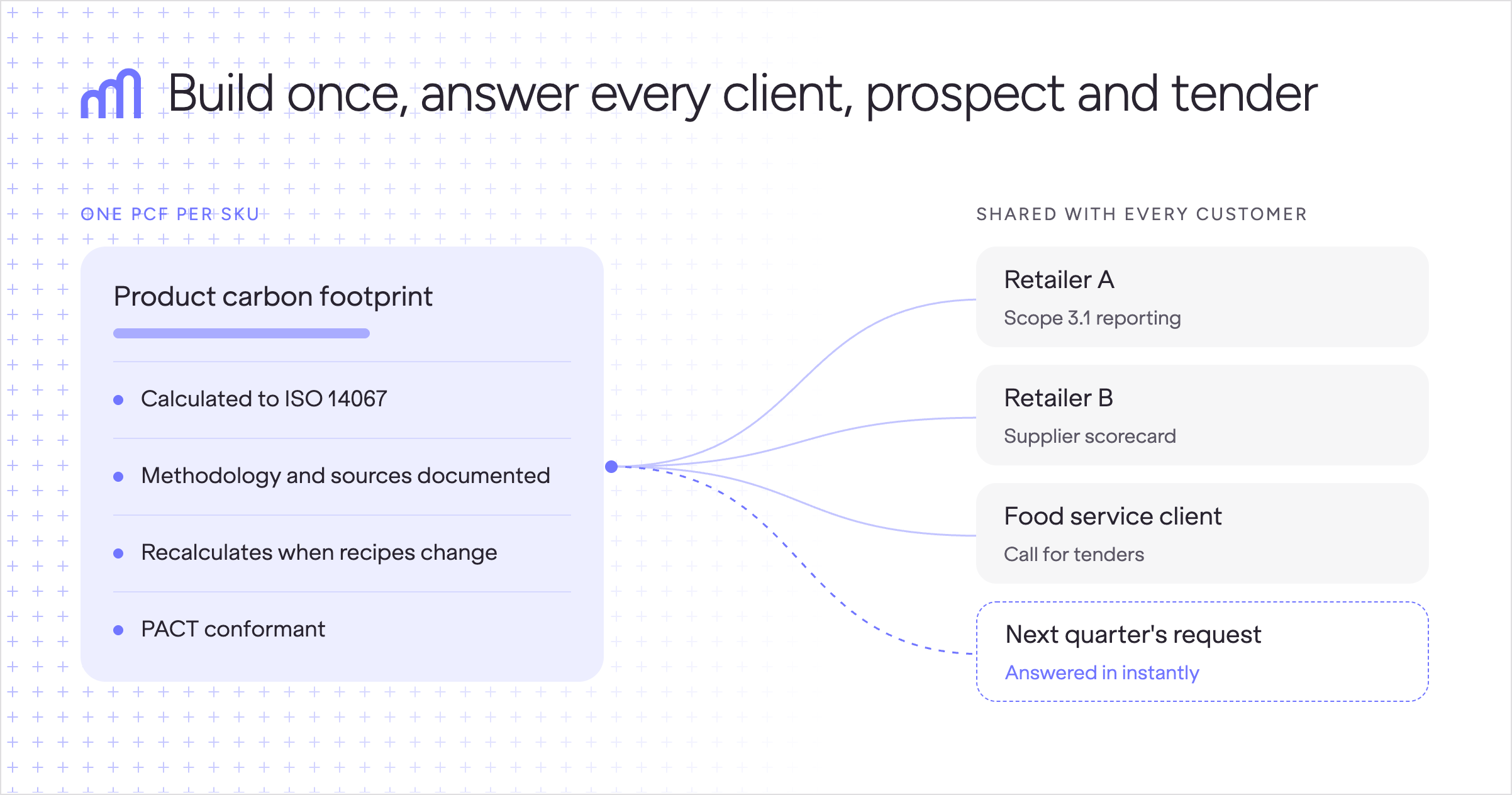
Treat the first request as the trigger to stand up a repeatable capability, not a project you take apart afterwards. The next retailer will ask too, recipes and suppliers change constantly, and the regulatory pull is widening. Under the CSRD's Omnibus revision, mandatory reporting now targets companies with more than 1,000 employees and over €450m in turnover, with the next wave reporting on 2027 data in 2028. Even if that leaves you outside direct scope, your in-scope customers still push data requests down the value chain, so the requests reach you regardless.
A one-off spreadsheet cannot carry this. One manufacturer was producing more than 800 footprints from a single Excel file maintained by one person, which works until that person is unavailable or the volume doubles. Choose an approach that recalculates automatically when a recipe or an emission factor changes, stores the audit trail by default, and scales across the portfolio without adding a consultant per product.
Yes, provided it is built to hold up outside a single customer relationship. A PCF calculated to a recognised standard, typically ISO 14067, with its methodology and data sources documented, can be shared with every customer who asks. PACT conformance goes one step further: it lets the same figure be exchanged in a format other companies' systems already recognise, so the second request becomes a matter of sending data rather than rebuilding it.
The test is simple: when the second retailer asks next quarter, can you answer in days rather than starting over?
A retailer asking for product carbon data is an early signal of where the whole market is heading. Product-level environmental data is becoming a condition of doing business, driven by retailers moving ahead of regulation rather than waiting for it. Answering one email well is worth doing; building the capability to answer the next ten is what actually protects your accounts.
Start with the request already in your inbox. Run step one on it today: confirm the metric, the standard, the scope, the deadline and the intended use before you commit to anything. Everything else in this guide gets easier once the ask is defined.
Facing a wave of retailer carbon data requests? See how food companies calculate product carbon footprints across thousands of SKUs, with an auditable, PACT-conformant methodology built for food supply chains.
Read next: Activity-Based vs. Spend-Based Carbon Accounting for Food
A product carbon footprint request is when a customer, usually a retailer, asks a supplier to report the greenhouse gas emissions of specific products, typically in kg CO2e per unit or per kg. Retailers use these figures for their own Scope 3.1 reporting, for supplier scorecards and, increasingly, for consumer-facing labels.
For each product, you need the product name and EAN (or International Article Number), net weight, full composition with ingredient percentages, packaging specifications and ingredient origins. Purchased volumes also help you prioritise. In most food businesses this data sits across a PLM or ERP, retailer spec platforms, spreadsheets and documents, so extracting it is usually the main bottleneck.
You can start with generic, food-specific emission factors to build a first baseline and identify hotspots. Then replace them with primary supplier data where it changes the result, usually for the two or three ingredients or stages that drive most of the impact. Whichever you use, tell the retailer which parts of each figure rest on primary data and which on secondary factors.
Ask the retailer first, since the answer depends on how the figure will be used. ISO 14067 is the international standard for quantifying a product's carbon footprint. The EU's PEF method covers 16 environmental impact categories, not just carbon. PACT is a framework for calculating and exchanging PCF data consistently between companies, which makes figures comparable across suppliers.
Very likely, yes. Under the CSRD's Omnibus revision, mandatory reporting now targets companies with more than 1,000 employees and over €450m in turnover. Even if you fall below those thresholds, customers that are in scope still need emissions data from their suppliers, so requests keep coming down the value chain.






.svg)