


Corporate climate action is entering a critical new phase. For years, the focus was on measuring footprints and making promises; now, the pressure is on to deliver real results. Because a food company's supply chain (Scope 3) often represents the vast majority of its overall environmental impact, actively engaging suppliers is no longer just a sustainability goal, it is a core business necessity. In this article, we explore why supplier engagement is entering a new era, why the shift to glidepaths is critical, and the practical steps leading food companies are taking to turn climate goals into everyday business reality.
Corporate climate strategies in the food industry are rapidly shifting from awareness to action. According to the 2026 barometer on climate strategies in the food industry, food companies are navigating unprecedented macro pressures: volume fluctuations, portfolio optimization trade-offs, and intense commodity cost volatility. In this environment, sustainability decisions directly affect costs, sourcing strategy, and risk management.
Scope 3 emissions, which often represent the majority of a food company’s footprint, are now central to both impact and risk management. In fact, for nearly 60% of large companies in the food industry, risk mitigation and impending regulation have become the primary drivers of climate strategy adoption. This shift is forcing organizations to reassess how their supply chains are structured, managed, and incentivized.
At the same time, regulations and climate standards are becoming more demanding. The updated Net-Zero Standard from the Science Based Targets initiative (SBTi), which will take effect in 2027, significantly changes how companies must manage supply chain emissions. Under the new framework, supplier alignment is no longer just a sustainability goal, it becomes a measurable procurement KPI.
Companies will need to track the share of their procurement spend that goes to suppliers with validated science-based targets. By 2030, all emissions-intensive suppliers, such as those in livestock, dairy, soy, and palm oil, must be aligned. By 2050, this requirement extends to all tier-1 suppliers.
Decarbonization must now be embedded directly into purchasing decisions and daily sourcing operations.
In this context, traditional supplier engagement models are under strain. The expectations placed on food companies have evolved, and supplier engagement must evolve with them.
To learn more about SBTi Net-Zero Standard V2 -> read our guide.
In the past, supplier engagement often relied on rough estimates and broad outreach. Companies used industry averages and secondary data to calculate their emissions and identify major problem areas. This was helpful for getting started, but it didn’t provide enough detail to understand what was happening at the individual supplier level or to drive real changes in operations.
At the same time, many companies tried to engage all suppliers in the same way. In reality, suppliers (especially farmers and processors) work with tight margins and limited resources. When expectations are applied evenly across the board, without prioritizing the highest-impact areas or offering targeted support, the burden of reducing emissions can fall unfairly on those least able to manage it.
Climate reporting has also often been disconnected from day-to-day business decisions. Emissions data is typically collected once a year for sustainability reports, rather than being integrated into regular sourcing and purchasing processes. As a result, suppliers are frequently asked to provide data that does not lead to clear feedback or meaningful action, leading to growing frustration and “data fatigue.”
High-level averages and annual reporting cycles cannot provide the accuracy, focus, or accountability that today’s climate standards require.
To move beyond these limitations, experts at Carbon Maps and Quantis have described a clear progression in how companies approach climate action.
In 2022, many companies worked with what could be called a “generic baseline.” They calculated emissions using broad averages by ingredient. This helped identify major impact areas and set initial targets, but it didn’t provide enough detail to see whether individual suppliers were actually improving.
By 2025, more advanced companies began shifting to a “representative baseline.” Instead of relying only on averages, they started looking at emissions by specific supplier, ingredient, and origin. With this added detail, procurement teams could focus on the suppliers that contribute the most emissions and direct time and investment where it would have the biggest impact. The priority became clear: focus on the suppliers that matter most and track real reductions over time.
Looking ahead to 2030, the next stage is the Glidepath model. This approach goes beyond measuring past emissions. Companies work with suppliers to build clear reduction plans and estimate how emissions will decrease in the future. Progress is tracked regularly, and improvements are measured over time. Supplier engagement becomes less about reporting what happened last year and more about planning and managing change going forward.
.jpg)
As the barometer shows a clear path toward 2030, leading food companies are already putting this next stage into practice.
To learn more about Climate Strategies in the Food sector -> read our Barometer
Leading food companies are not treating supplier engagement as a reporting exercise. They are redesigning it as a core part of business strategy. The shift is clear, and it offers a practical roadmap for others to follow.
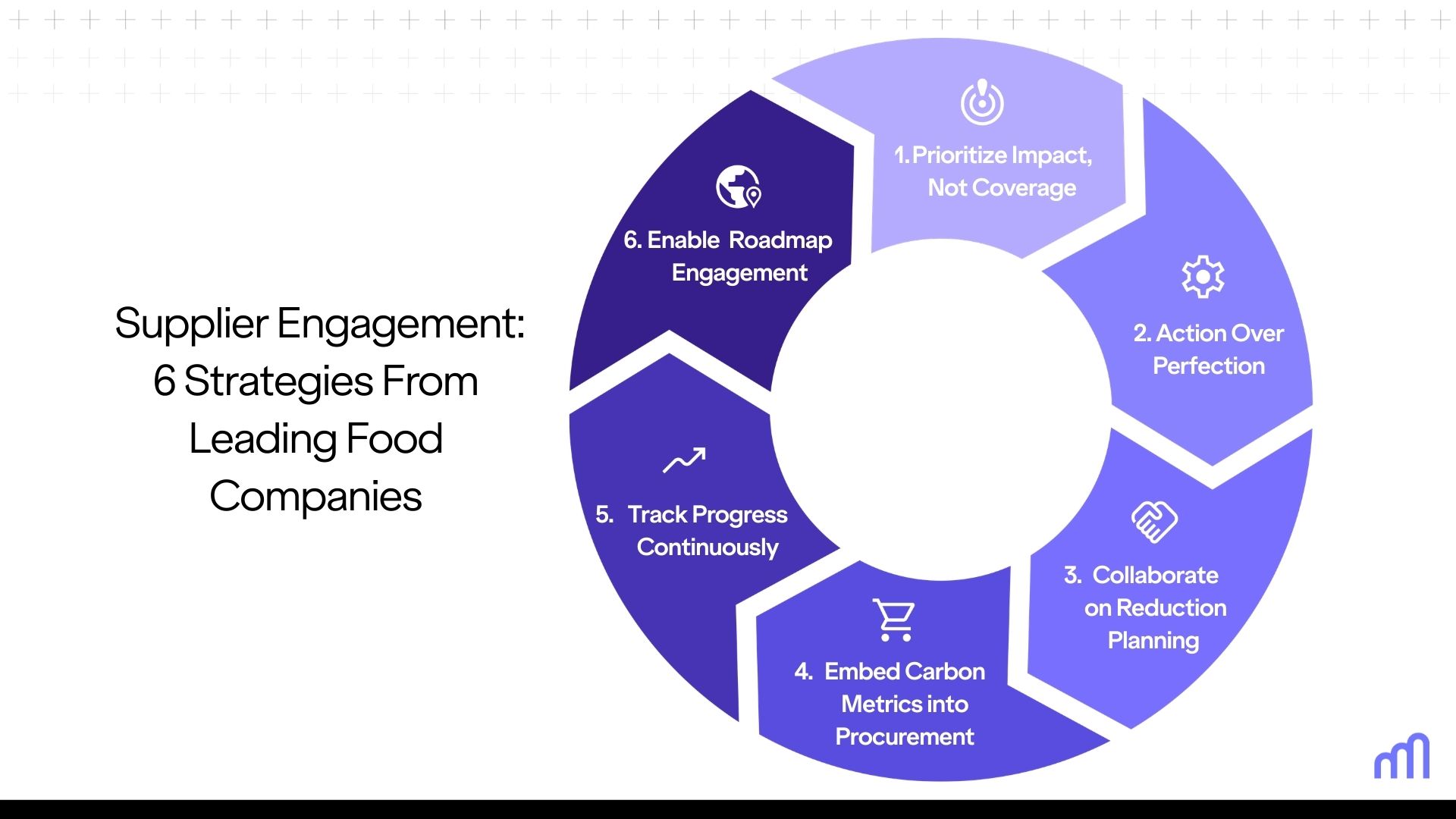
Rather than engaging every supplier equally, leading companies focus on the areas that drive the majority of their emissions. For example, Heineken concentrates on agriculture and packaging, which account for roughly 60% of its footprint. This targeted approach allows them to target high-leverage areas like fertilizer decarbonization and returnable bottles rather than blanketing their entire supply chain.
How to start:
Map your emissions at portfolio level and identify the top contributors. Using a platform like Carbon Maps can help identify hotspots in supply chain;, Cooperative U, a leading French retailer, can now easily see carbon emissions hotspots by category and by supplier, making it easier to plan action with the most impact. Read the full client success story here.
Leading companies do not wait for complete primary supplier data before taking action. Instead, they combine high-quality secondary data with targeted primary data collection in high-impact areas (‘hotspots’). Unilever embodies 'action over perfection' by targeting emissions hotspots where data is already sufficient. They focus on their most carbon-intensive suppliers rather than waiting for a perfect map of all 50,000+ vendors.
This allows them to move faster and reduce risk sooner.
How to start:
Use smart estimates, like industry averages for your specific ingredients and regions, to gain directional insight to get started, and reserve intensive primary data collection only for strategic hotspots.
Rather than asking suppliers only to disclose emissions or commit to vague targets, leading companies work in collaboration with suppliers to define clear reduction plans. PepsiCo shows how this collaboration works in practice with its 'Ag Supplier Playbook', a guide with practical examples, worksheets, and tools to help agricultural suppliers create an action plan that works for their specific land and crops.
This shifts the conversation from compliance to co-creation. The result is a more trusted, forward-looking partnership focused on practical, shared progress.
How to start:
Choose a small group of priority suppliers and start with open, structured conversations. Share your understanding of where the biggest emissions sit and ask for their perspective. Together, identify a few practical actions that could realistically reduce emissions, and agree on what progress would look like over the next few years.
Leading companies include climate performance in their regular sourcing processes. Instead of reviewing carbon figures once a year for a sustainability report, they use this information to help guide day-to-day buying decisions. At Mars, Inc., environmental impact is considered alongside cost, quality and delivery in sourcing choices, every time a purchasing decision is made. The company has ‘woven environmental impact into the fabric of procurement decision-making’. This ensures that procurement teams are rewarded for sourcing decisions that support long-term climate goals.
How to start:
Start by adding one sustainability metric, like a supplier’s Product Carbon Footprint or CSRD maturity within your portfolio, into the usual bidding process. Weighing this alongside price and quality will integrate climate impact as a natural part of procurement decisions in the future.
Leading companies monitor supplier-level intensity reductions over time. Progress is measured, adjusted, and communicated transparently. General Mills, for instance, uses satellite imagery and soil modeling to continuously track the adoption of regenerative farming practices. This allows them to oversee millions of acres and estimate real changes in net greenhouse gas (GHG) emissions from the farms in their supply chain.
How to start:
Create a simple way to track your most important suppliers over time. This doesn’t have to be manual: leading distributors like Solinest have used Carbon Maps to replace time consuming emails with automated dashboards to track supplier progress in real-time.
Executing this roadmap-driven model at scale requires infrastructure that bridges sustainability ambition and procurement execution.
Carbon Maps provides that foundation, purpose-built for the complexity of agricultural value chains. While many companies collect Product Carbon Footprints, those data points often remain difficult to validate, benchmark, or operationalize. Carbon Maps transforms PCFs into auditable, standardized specifications that can be used consistently across supplier evaluation and sourcing decisions.
As a PACT-conformant solution, Carbon Maps transforms these footprints into auditable, standardized specifications that can be shared and used consistently across the entire food supply chain. This conformance ensures interoperability, meaning your carbon data is not trapped in a silo, but can be seamlessly exchanged with suppliers and customers using a globally recognized standard.
The platform automates annual data pipelines, integrating purchase volumes, supplier information, farming practices, and emission factor updates- reducing manual effort while improving accuracy year over year. It enables companies to score products, prioritize hotspots, and implement tailored engagement strategies based on supplier impact and maturity.
In doing so, Carbon Maps allows food companies to meet the evolving demands of engaging suppliers to align with global frameworks and reporting standards while turning Scope 3 insight into actionable procurement decisions.
Book a demo to see how Carbon Maps helps engage suppliers in a shared climate journey.





.svg)


