


EUDR Compliance for Food Companies

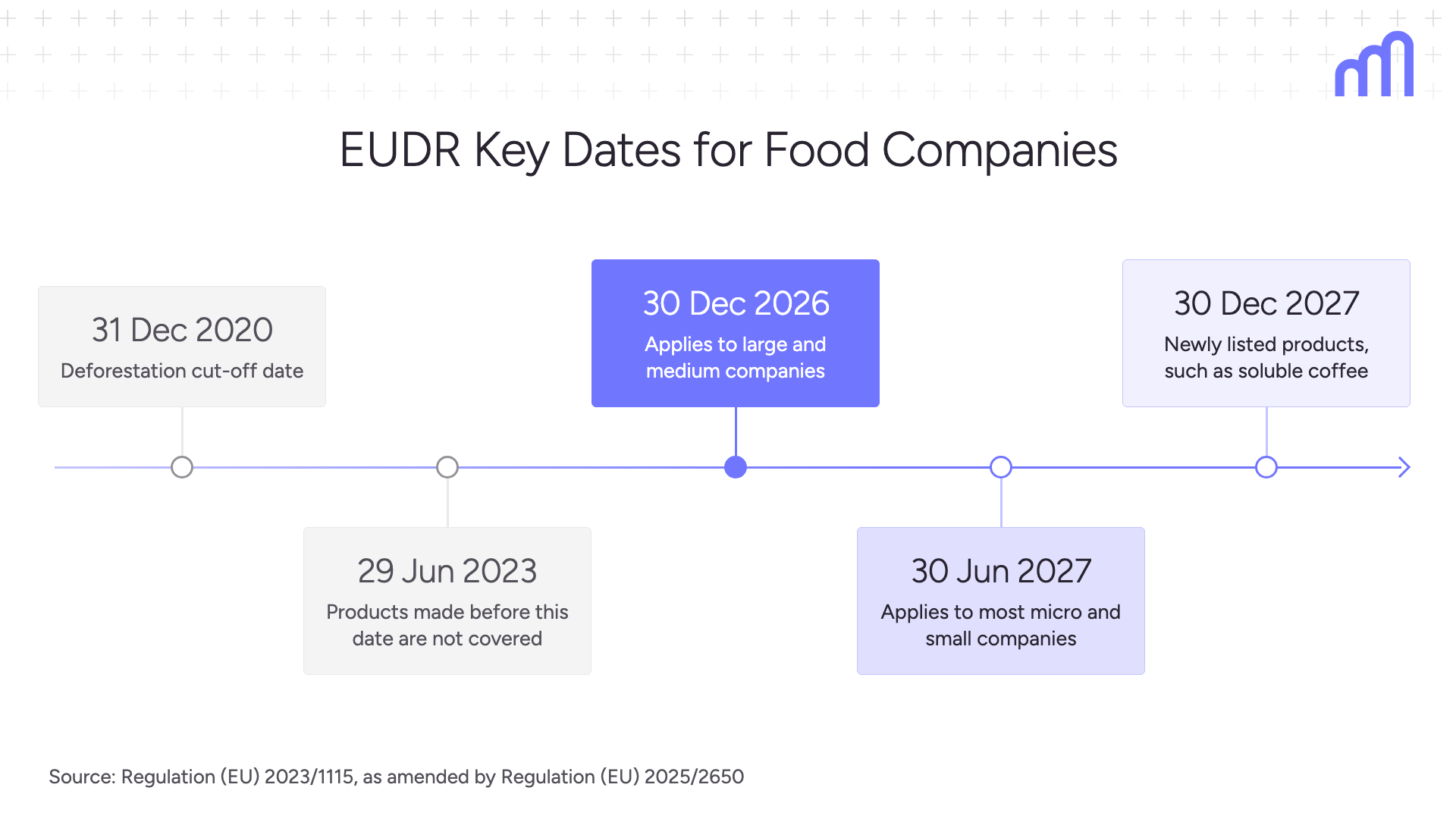
- EUDR compliance for food companies starts on December 30, 2026 for large and medium companies and on June 30, 2027 for most micro and small companies, and bars products from land deforested after December 31, 2020.
- For food companies, the EUDR covers cocoa, coffee, palm oil, soy and beef, but only the products listed by customs code in the regulation's official annex.
- Since the December 2025 amendment, only the company that first places a product on the EU market files a due diligence statement, while companies buying from EU suppliers mainly keep supplier details and statement reference numbers.
- Carbon Maps, the product carbon footprint platform for the food industry, notes that the farm-level supplier data food companies collect for EUDR compliance can also be used to calculate auditable product carbon footprints.
The EU Deforestation Regulation (EUDR) changes how food businesses source agricultural commodities for the European market. Achieving EUDR compliance for food companies requires procurement teams to verify the origin of specific ingredients and collect targeted supplier data before products enter or leave the EU.
Rather than overhauling your entire purchasing operation, meeting these rules comes down to knowing which ingredients are covered, understanding your exact position in the supply chain, and gathering the right documentation.
What Is the EU Deforestation Regulation and When Does It Apply?
The EU Deforestation Regulation is a European law designed to prevent products linked to forest loss from being sold in or exported from the European Union. Under Regulation (EU) 2023/1115, any covered product placed on the EU market must meet three conditions:
- It must be deforestation-free, meaning the raw materials were not produced on land deforested after December 31, 2020.
- It must be produced in line with the laws of the country where the raw materials were grown or raised.
- It must be covered by a due diligence statement, filed in the EU's online system before the goods are sold in or exported from the EU.
In its May 2026 simplification review, the European Commission concluded that no further changes to the regulation's text are needed. Procurement teams can now plan around stable rules.
Key dates to keep in mind
Following updates under Regulation (EU) 2025/2650, the rules apply on different dates depending on company size:
- December 30, 2026: the EUDR applies to large and medium companies, and to micro and small timber businesses.
- June 30, 2027: the EUDR applies to most other micro and small companies.
- December 30, 2027: newly listed products, such as soluble coffee, become covered under a 2026 update to the product list.
Products produced before June 29, 2023 are not covered.
Which Food Ingredients Are Covered by the EUDR?
The regulation covers seven raw materials: cattle, cocoa, coffee, oil palm, rubber, soy and wood. It also covers specific products made from them, listed by customs code in the regulation's annex. For food procurement teams, five matter most:
- Cattle: live cattle, beef and certain offal.
- Cocoa: beans, paste, butter, powder and chocolate.
- Coffee: green, roasted and decaffeinated coffee.
- Oil palm: palm oil, palm kernel oil and a range of palm-based ingredients.
- Soy: soybeans, soy flour and meal, soybean oil and soy oilcake.
Only products on this official list are covered. A finished product that contains palm oil or cocoa is not covered unless its own customs code appears on the list. The list also changes over time, so check it again whenever it is updated.
Cardboard boxes and wooden pallets used only to ship or protect your ingredients are not covered. The Commission's guidance explains how to check each product.
What EUDR Compliance for Food Companies Requires by Supply Chain Role
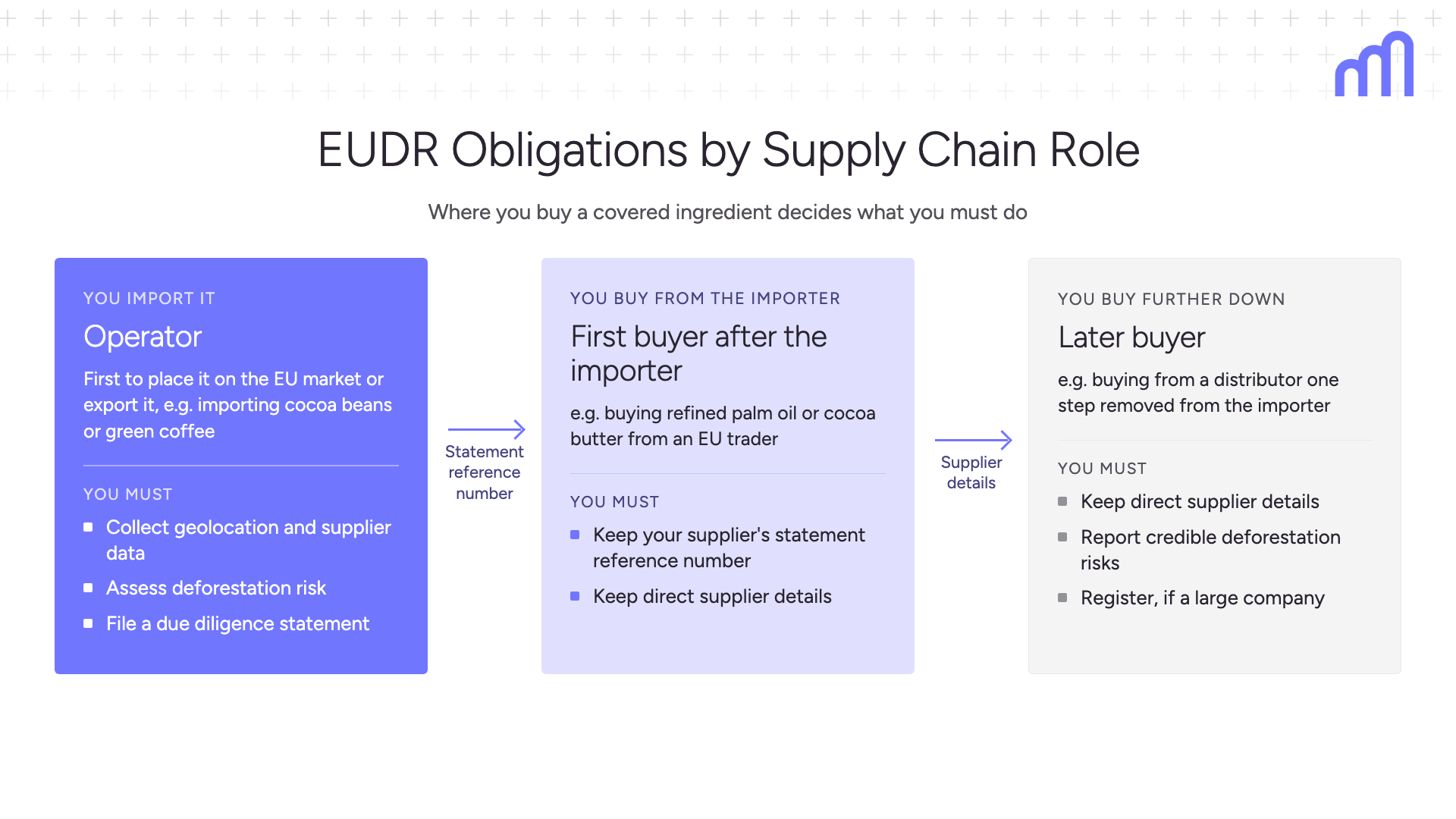
Your obligations depend on where your company sits in the supply chain when a covered ingredient enters the EU. Since Regulation (EU) 2025/2650, the paperwork is no longer repeated at every step of manufacturing.
If you import ingredients yourself
If you are the first company to sell a covered product in the EU, or to export it, the law calls you the "operator." This is the case if you bring cocoa beans, green coffee or crude palm oil into the EU yourself. It is also the case if you are the first to sell soy grown or cattle raised in the EU.
Operators carry the main compliance obligation. Before selling the goods, you must collect supplier data, assess the risk of deforestation, and file a due diligence statement. This is an electronic declaration confirming that you checked the supply chain and found no or negligible risk.
Very small farms in low-risk countries that sell their own produce can file a simplified one-off declaration instead. If you import from small farms, you still file the full statement yourself.
If you buy directly from the importer
Many European food companies buy processed ingredients, such as refined palm oil, cocoa butter or roasted coffee, from an EU-based trader or processor that imported the raw material. In that case, you no longer submit your own due diligence statement. As the first buyer after the importer, you collect and keep the reference number of the statement your supplier filed.
If you buy further down the chain
If you buy from a distributor that is already one step removed from the importer, your duties are lighter still. You don't need to file statements or pass reference numbers along.
You are not exempt, though. If you learn of credible information that an ingredient may be linked to deforestation, you must inform the authorities. Large companies at any step after the importer must also register in the EU's online system.
What Data Your Suppliers Must Provide
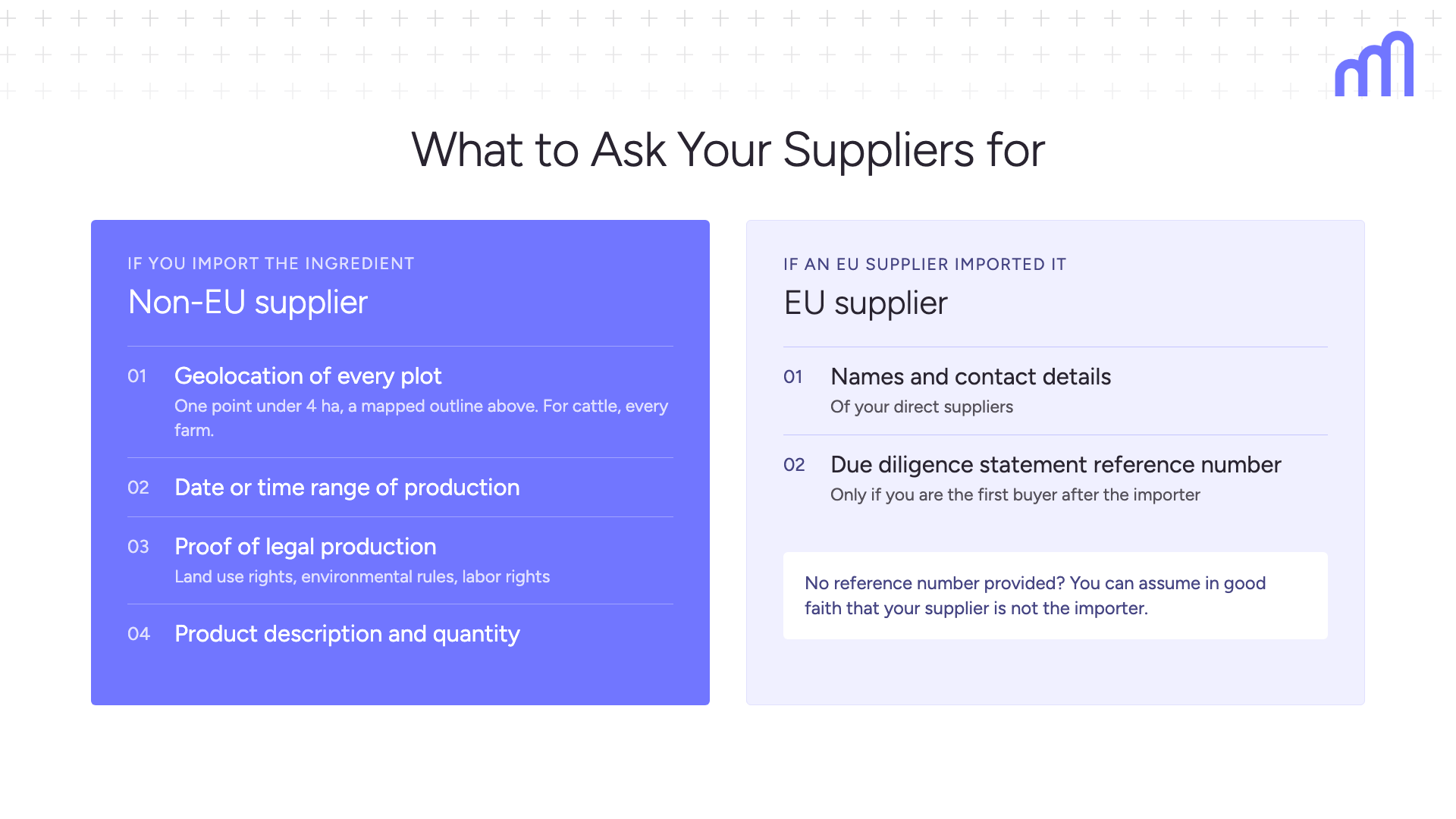
When you import covered ingredients, your supplier must provide:
- The geolocation of every plot of land where the raw materials were produced. One coordinate is enough for plots under four hectares, while larger plots need a mapped outline. For cattle, you need one coordinate for each farm where the animals were kept.
- The date or time range of production.
- Evidence that the product was produced in line with local laws, such as land use rights, environmental rules and labor rights.
- Product details, including a description and quantity.
When you buy from an EU supplier, your request is simpler. You need the names and contact details of your direct suppliers and, if you are the first buyer after the importer, the due diligence statement reference number. If no reference number is provided, you can assume in good faith that your supplier is not the importer.
How the EUDR Is Enforced
Each EU country has a national authority that checks compliance. The share of companies checked depends on the risk level of the producing country: 1% for low risk, 3% for standard risk and 9% for high risk.
Each country sets its own penalties, but the regulation requires maximum fines of at least 4% of a company's annual EU turnover. Authorities can also confiscate products and revenues and temporarily exclude companies from public contracts.
Practical Steps for Procurement Teams
Four actions cover most of the work.
- Map your ingredients against customs codes. Flag every ingredient containing cattle, cocoa, coffee, palm oil or soy, and check its customs code against the official list with your customs broker.
- Sort suppliers by supply chain position. Separate the non-EU suppliers you import from and the EU suppliers that handle the import themselves. This tells you who must provide geolocation data and who only needs to pass on a reference number.
- Update supplier contracts. Add data-delivery clauses to new contracts and renewals, stating that geolocation files or reference numbers must arrive before shipment.
- Store supplier data by batch. Keep reference numbers and geolocation files with your existing traceability and quality records, linked to purchase orders, so you can respond quickly to checks or customer requests.
Reusing EUDR Supplier Data for Product Carbon Footprints
The farm-level data collected for the EUDR also shows exactly where ingredients come from, so product carbon footprints can reflect each ingredient's real origin.
If you are already collecting farm locations and supplier records for the EUDR, Carbon Maps can use that same data to calculate auditable carbon footprints for your food products. The supplier data you gather for EUDR compliance then serves your carbon reporting too.
Already collecting supplier data for the EUDR? Put it to work for your product carbon footprints.
Talk to an expertEUDR FAQ for Food Procurement Teams
Does the EUDR apply if we only buy ingredients from EU suppliers?
Yes, but your duties are lighter. You don't file a due diligence statement. You keep the names and contact details of your direct suppliers, and if you are the first buyer after the importer, you also keep the statement's reference number. If you learn of credible information linking an ingredient to deforestation, you must inform the authorities.
Is every product that contains palm oil or cocoa covered?
No. Only products on the regulation's official list are covered, and the list works by customs code. The European Commission gives the example of soap, which is not covered even when it contains palm oil.
Does the EUDR cover ingredients grown in the EU?
Yes. The rules apply wherever a covered ingredient was produced. The first company to sell EU-grown soy or EU-raised cattle on the EU market has the same duties as an importer.
Does a sustainability certification prove EUDR compliance?
No. Certification schemes can support compliance, but they do not replace the legal due diligence obligation. You still need the information the regulation asks for, including the location of the land where the ingredient was produced.
What happens if a supplier can't provide geolocation data?
If you import the ingredient, you cannot sell it in the EU. Without geolocation, products cannot be placed on the EU market. Start asking suppliers for this data early, and plan alternative sources where it is hard to get.
Related content
CSRD Guide for Food and Beverage 2026
