Since 27 September 2026, the Empowering Consumers Directive (EmpCo) has applied across the EU. It changes what food brands can say about the environment on pack, on product pages and in ads. Vague words like "eco-friendly" are now off limits for most products, "carbon neutral" claims based on carbon credits are banned, and homemade sustainability logos have to go.
If you work in marketing or sustainability at a food company, three questions follow: which claims can stay, which must go, and what proof the remaining ones need. This article answers all three, compares EmpCo with the proposed Green Claims Directive, and ends with a four-step review to run before your next pack refresh.
EmpCo, formally Directive 2024/825, doesn't create a new regulatory regime. It updates the EU's existing consumer protection laws (the Unfair Commercial Practices Directive (UCPD) and the Consumer Rights Directive) with a list of greenwashing practices that are now banned outright. The European Commission describes the result as a consumer protection "safety net" across sectors.
France hasn’t yet passed the law that puts EmpCo into effect. Brands shouldn’t wait for it, though. The DGCCRF, France’s consumer protection authority, can already penalise misleading green claims under current consumer law.
For food brands, four changes matter most.
EmpCo applies to anything you say to consumers: packaging, product pages, ads, and even brand or product names if they suggest an environmental benefit. Imagery counts, too.
According to the European Commission's Q&A on the Directive, a green leaf or water drop next to a written claim can count as a claim in itself.
Two things fall outside EmpCo:
EmpCo is mandatory and therefore applies to every business that markets products to consumers in the EU, whatever its size. Making environmental claims stays optional, but any claim you do make has to follow the new rules.
EmpCo doesn't set fines itself. Each country enforces it through its own consumer law, and competitors and consumer associations can also take brands to court. When a misleading claim reaches consumers in several EU countries, authorities can act together, with fines of 4% or more of the company's annual turnover in the countries concerned, or at least €2 million where turnover figures aren't available.
In France, a misleading green claim is treated as a misleading commercial practice (pratique commerciale trompeuse). The fine can reach 10% of average annual turnover, or 80% of what the company spent on the misleading campaign, and courts order the sanction to be published. France hasn't yet passed the law that puts EmpCo into effect, but the DGCCRF can already penalise misleading green claims under these existing rules.
You can still talk about the environment under EmpCo, as long as you are precise. A claim is no longer considered vague when you explain it clearly in the same place. The Commission gives this example: "climate-friendly packaging" is vague, while "100% of the energy used to produce this packaging comes from renewable sources" is specific.
The same goes for carbon. You can say a product has a "reduced CO2 impact" if you explain the reduction on the pack or page, and it comes from real changes in how the product is made. That raises three questions any consumer authority could ask: reduced compared to what, by how much, and how was it measured? To answer them, you need the product's carbon footprint, calculated from its actual recipe, ingredients and production, not an industry average that applies to every competitor too.
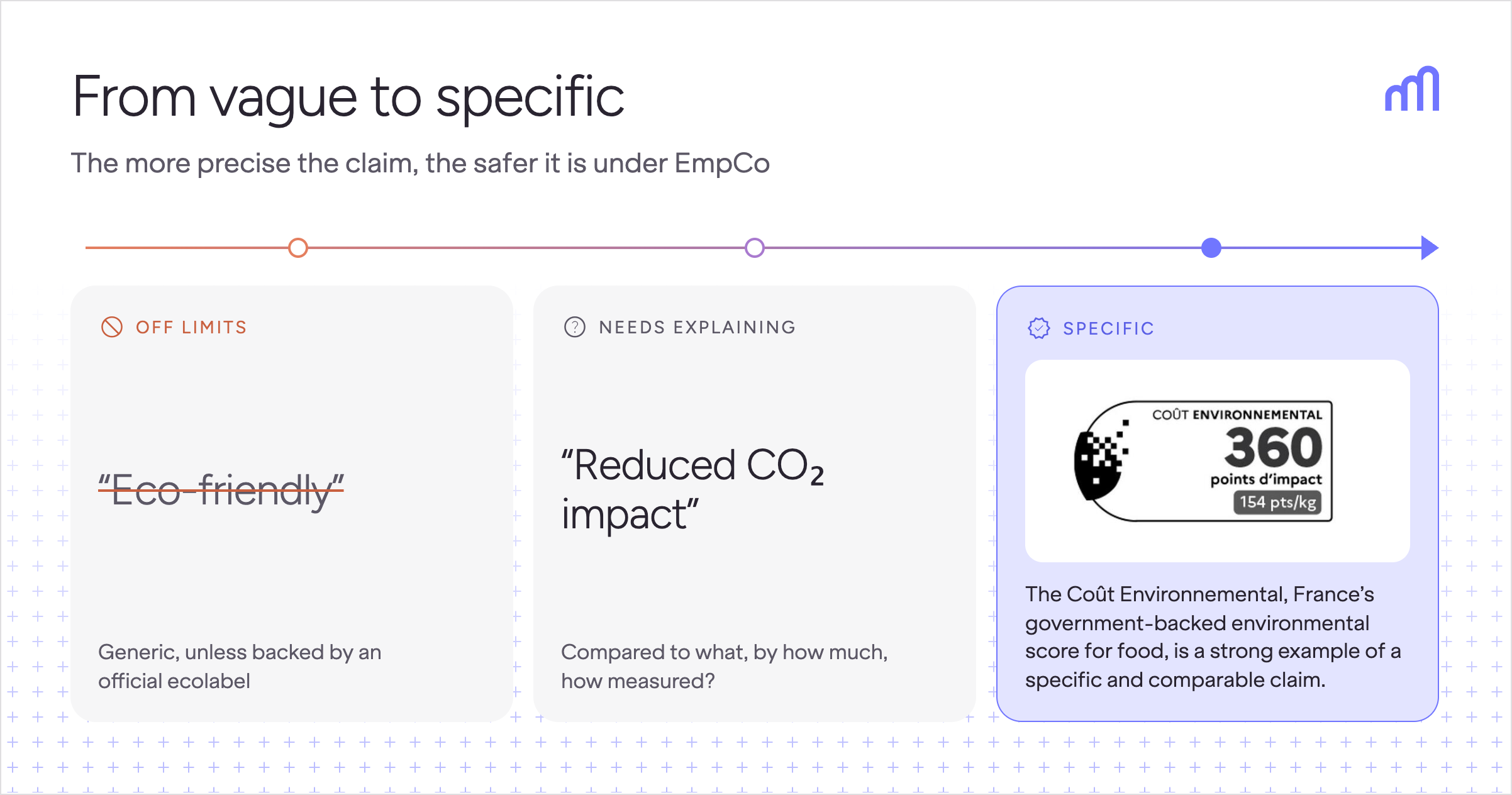
E.Leclerc offers a good example. In April 2026, the retailer started showing the Coût environnemental (French Eco-Score for Food) on around 6,000 of its own-brand food products online. It's a voluntary score backed by the French government, using a calculation method published by the French ecological transition ministry and ADEME, the national environment agency, in May 2026. Carbon Maps calculated the scores for E.Leclerc’s range. Each product gets one score that combines 16 environmental impacts, from climate to water use and biodiversity. It's the opposite of a generic claim such as "eco-friendly". It is a specific figure, calculated the same way for every product, that shoppers can compare. Behind each score is an assessment of the product's impact over its whole life cycle.
The same applies to company targets. A target approved by the Science Based Targets initiative (SBTi) is a solid starting point, but EmpCo still requires an independent expert to check your progress regularly. For food companies, most emissions come from farming and ingredients, so showing progress means tracking emissions product by product as recipes and suppliers change.
EmpCo is often discussed alongside the Green Claims Directive, a separate proposal from March 2023 that would set detailed EU rules for proving and checking green claims. In June 2025, the European Commission said it intended to withdraw it, and the final negotiations were cancelled. It hasn't been formally withdrawn, so its future is uncertain.
Whatever happens to the proposal, EmpCo is the framework food brands must comply with today.
EmpCo makes vague claims risky and rewards brands that can show their numbers. Every claim that survives the new rules, from a reduced carbon footprint to a coût environnemental score, depends on accurate data for each product.
That’s what Carbon Maps provides. Our platform calculates the environmental footprint of every product in your range, using food-specific data and an ISO 14067-certified method. You get figures you can put on pack with confidence, track as recipes and suppliers change, and share with the experts who check your progress. It’s the same approach we used to calculate the Coût environnemental for E.Leclerc’s 6,000 own-brand products.
EmpCo is here. Your claims need proof. Carbon Maps calculates product-level footprints you can stand behind.
EmpCo has applied across the EU since 27 September 2026. It covers every business that markets products to consumers in the EU, whatever its size. Making environmental claims is optional, but any claim a brand makes on pack, online or in ads must follow EmpCo’s rules.
EmpCo is in force and bans specific greenwashing practices in marketing to consumers. The Green Claims Directive is a separate proposal from March 2023 that would set detailed rules for proving and independently checking green claims before use. Negotiations stalled in June 2025, and its future is uncertain.
Not in most cases. Under EmpCo, vague words like “eco-friendly” or “green” are banned unless the product holds an official ecolabel, such as the EU Ecolabel. “Carbon neutral” claims based on carbon credits are banned outright. Brands can still make specific claims, such as a product’s measured carbon footprint or a reduction in it, if the figures come from the product itself and are explained in the same place. “Organic” and “bio” remain allowed on certified organic products.
EmpCo doesn’t set fines itself. Each EU country enforces it through its own consumer law, and competitors and consumer associations can also take brands to court. When a misleading claim reaches consumers in several EU countries, fines can reach 4% or more of annual turnover in the countries concerned. In France, fines for misleading green claims can reach 10% of average annual turnover or 80% of the campaign’s cost, and the sanction is made public.