


Most food and beverage companies are treating PPWR compliance as a design brief: swap this material, redraw that label, hit a recyclability grade. That's the wrong mental model. PPWR is a data requirement wearing a packaging costume, and companies that treat it as a design-only problem will find themselves rebuilding the same supplier data pipeline twice.
Regulation (EU) 2025/40, known as PPWR, entered into force on 11 February 2025 and applies directly from 12 August 2026. It replaces the Packaging and Packaging Waste Directive (94/62/EC), which had governed EU packaging rules for three decades.
The shift from directive to regulation matters more than it sounds. A directive lets each member state write its own national version, which is how the EU ended up with 27 slightly different sets of packaging rules, symbols, and reporting formats. A regulation applies as written, in every member state, on the same date. There is no national transposition period and no local variation to negotiate. For a food brand selling across five or six EU markets, that's one compliance requirement instead of six.
PPWR covers the full packaging lifecycle: design and material composition, substances of concern, recyclability, labeling, reuse systems, and extended producer responsibility. Not all of it lands at once. Some provisions apply from August 2026, others phase in through 2030 and 2040. That staggered timeline is exactly why so many teams are unclear on what's urgent and what isn't.
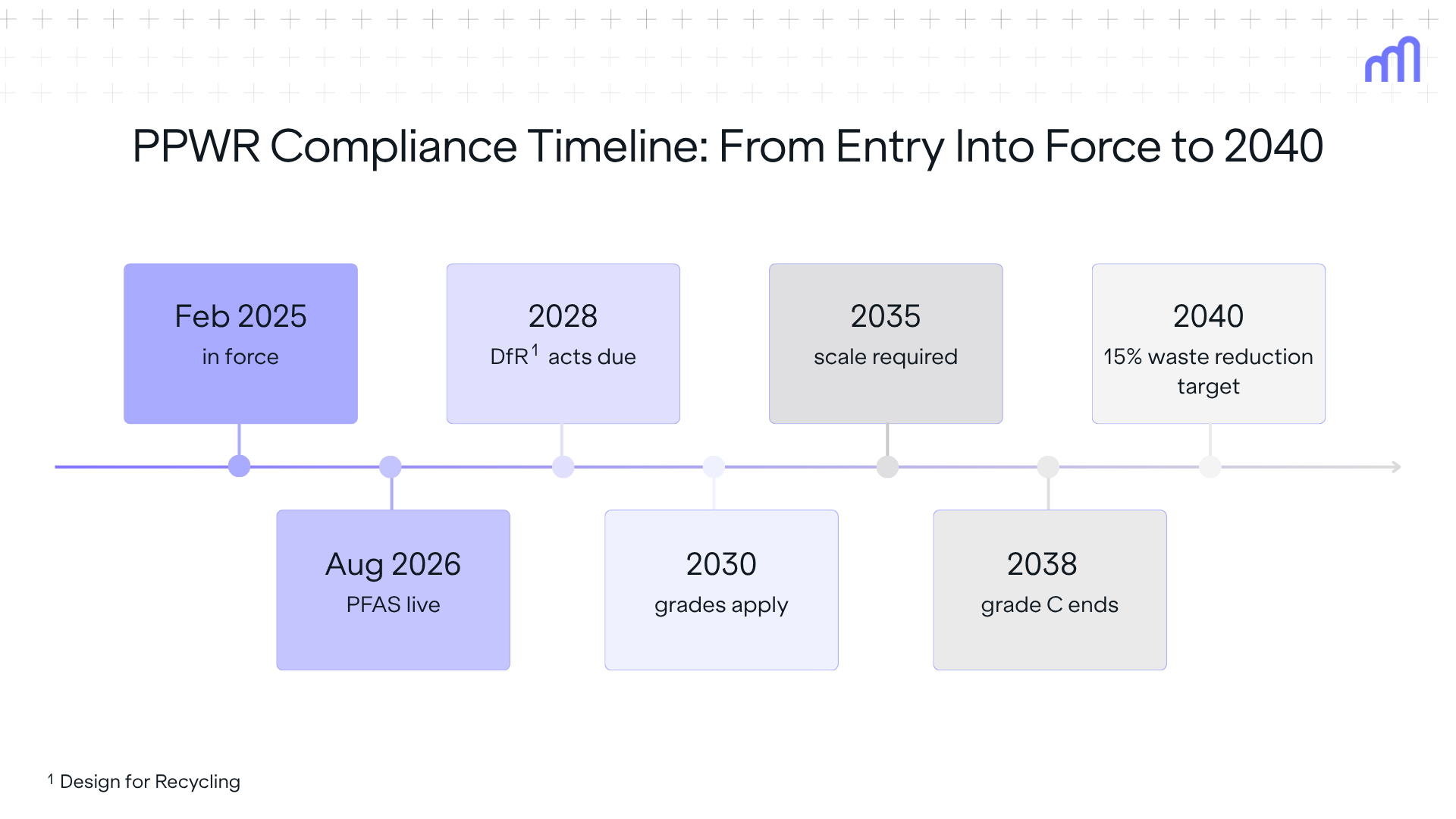
Here's exactly what has to be in place by that first hard deadline:
.png)
Several PPWR provisions were written with food packaging directly in mind, not as a side effect of broader packaging rules.
From 12 August 2026, food-contact packaging containing PFAS above specified concentration thresholds cannot be placed on the EU market. This is a hard compliance line, not a target to work toward.
Individual portion packaging for condiments and sauces is restricted, and takeaway food and beverage operators must let customers bring their own reusable containers at no extra charge.
From 2030, packaging is classified A through E based on recyclability, and only packaging graded C or above can be sold.
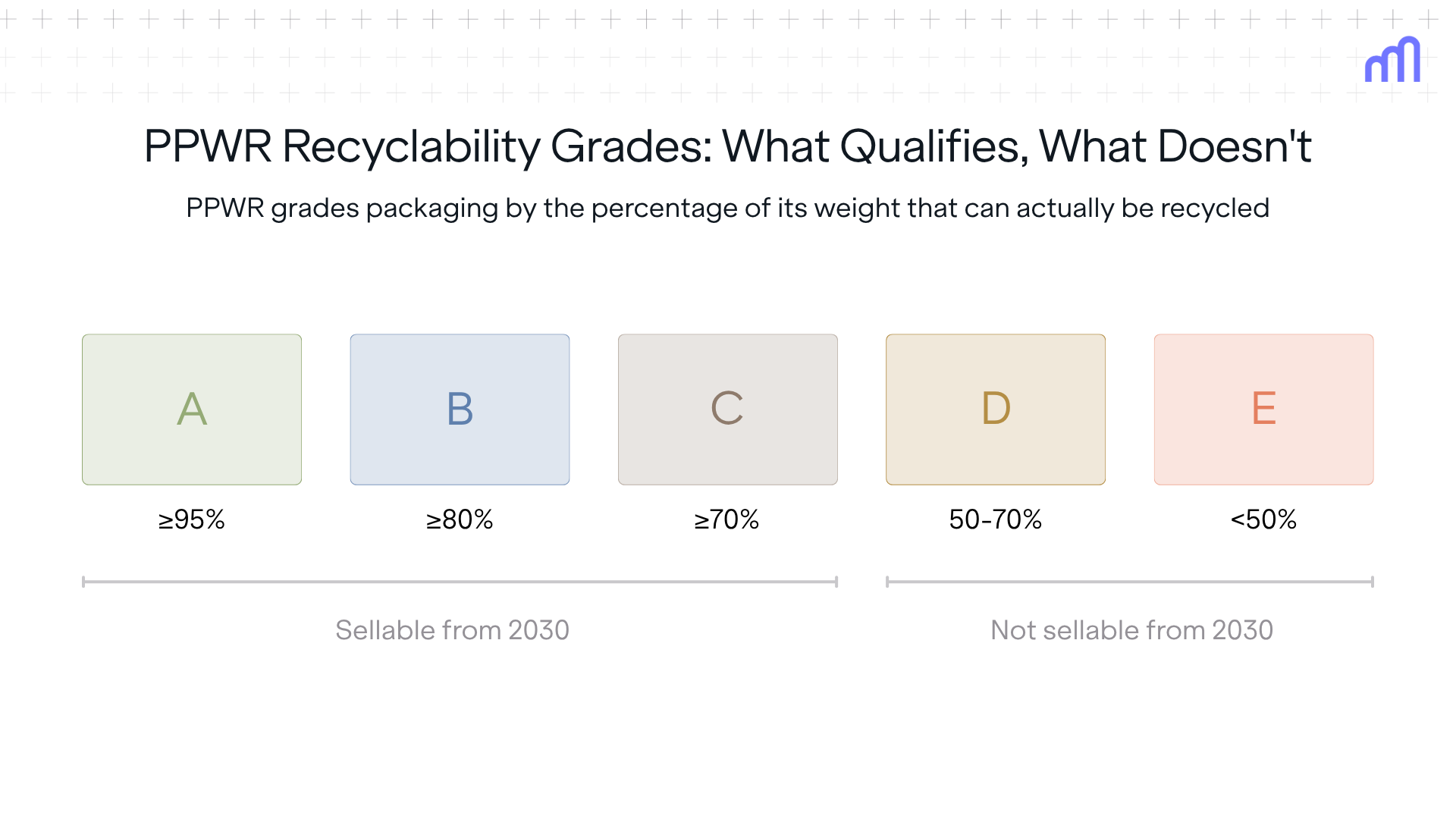
PPWR grades packaging by the percentage of its weight that can actually be recycled: 95% or more earns grade A, 80% or more earns grade B, and 70% or more earns grade C, the minimum needed to stay on the EU market from 2030. Multi-material formats common in food (laminates, composite trays, mixed-material pouches) are the formats most exposed here.
A recent Carbon Maps engagement with a leading French bottled water producer shows why this matters beyond compliance: product-level footprinting across 11 products found that packaging accounted for 44.3% of total impact, with PET preforms alone responsible for 74% of that packaging footprint. Increasing recycled PET content was identified as a lever worth up to 7% in emissions reduction on its own.
The same recycled-content data a bottled water producer needs to hit that reduction is largely the same data PPWR's recyclability grading and EPR fee modulation require. One data effort serves both purposes.
EPR contributions will be modulated according to recyclability, recycled content, and reusability. That means packaging choices now carry a direct, ongoing cost signal, not just a compliance checkbox.
For a brand running dozens or hundreds of SKUs across multiple packaging formats, none of these requirements can be answered with a single company-wide statement. They require format-by-format, and often supplier-by-supplier, documentation. Retailers running private label programs face the same exposure multiplied across every supplier's packaging line, often without direct control over the material choices being made upstream.
Here's the reframe: complying with PPWR means knowing, for every SKU, what the packaging is made of, what recyclability grade it carries, and whether it contains restricted substances. That has to be tracked at scale, kept current as formats and suppliers change, and backed by documentation you can produce on request.
That is structurally the same problem food companies are already solving for Scope 3 emissions and Product Carbon Footprint reporting under CSRD. We've written about what audit-ready carbon data actually requires, and the same discipline (traceable, supplier-sourced, product-level data instead of estimates) applies directly to PPWR documentation. The friction is identical: supplier data arrives in inconsistent formats, ownership of the data is unclear across procurement and packaging teams, and the requesting team ends up chasing the same suppliers that sustainability teams are already chasing for emissions data.
Companies that build PPWR compliance as a standalone packaging-team exercise will end up running two parallel supplier data campaigns asking overlapping questions. Companies that route PPWR data collection through the same supplier engagement process they've already built for carbon reporting get the answer once and use it twice.
This isn't a stretch of the regulation's intent. Packaging is also one of the material inputs in a product-level carbon footprint. A supplier that can tell you the recycled content and recyclability grade of a pack is very often the same supplier who holds the emissions data for that same packaging line. Treating these as separate requests multiplies supplier fatigue for no reason.
Ahead of August 2026, three actions matter more than the rest:
CSRD and PPWR read like different regulatory demands. In practice, they're asking the same underlying question in a different language: can you show, with product-level detail, what's actually in your supply chain? Food companies that have already invested in that kind of data infrastructure for carbon reporting are not starting from zero on PPWR. Companies still working from category-level averages and annual supplier surveys are solving the same problem for the third time.
Getting PPWR compliance right starts with the same supplier data most teams are already collecting for carbon reporting. If your team is already mapping Scope 3 supplier data for carbon footprint reporting, this is worth a conversation with your packaging team before you build a second, parallel process for PPWR.
PPWR and CSRD both draw on the same underlying supplier data. Carbon Maps helps food and beverage companies structure that data once, at the SKU level, so it holds up for carbon reporting, packaging compliance, and whatever regulation comes next.
Book a demo to see how it works for your packaging portfolio.





.svg)


