


If your sustainability team has been following the SBTi's Corporate Net-Zero Standard Version 2.0 since our November 2025 breakdown, here is the update you have been waiting for.
The final Version 2.0 was published on June 11, 2026 and while the overall architecture from November is intact, several provisions were revised in ways that will materially affect how food companies plan, set targets, and demonstrate progress. Some of those revisions are genuine improvements. One in particular may require updating assumptions your team made based on the draft. The final standard took Scope 3 in a different direction than many expected.
Here is what changed, and what it means for your team.
The November draft described a four-stage cycle: Entry Check → Initial Validation → Renewal Validation → Spot Checks. The final standard streamlines this to two stages:
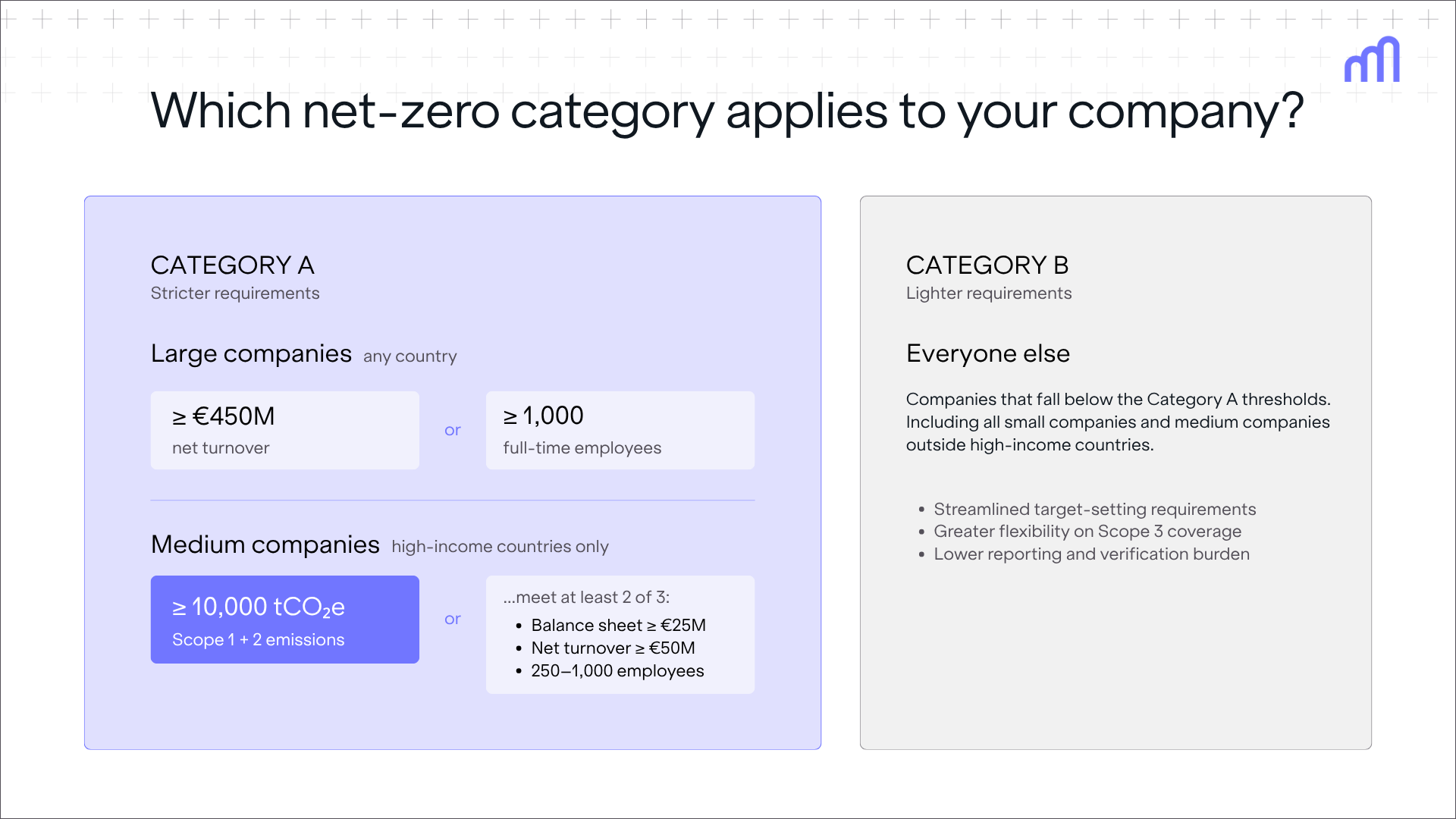
The Entry Check has been absorbed into the registration process rather than treated as a formal validation stage. Spot checks are no longer mentioned as a distinct mechanism.
For food companies, this matters because it clarifies when the clock starts, what triggers the five-year renewal, and what assured data needs to look like at end of cycle. Simpler process, but stricter data requirements at each gate.
This is the most significant change and the one most at risk of being mischaracterised.
The November draft defined three target-setting types for Scope 3: (1) emissions intensity targets, (2) activity alignment targets, and (3) counterparty alignment targets, with separate rules for each GHG Protocol category (Category 1 through 14). In practice, this produced a dense, category-by-category matrix that most companies found very difficult to navigate.
The final standard replaces all of that with three overarching options:
The coverage threshold also changes. The old 67% rule (covering at least 67% of your total Scope 3 inventory) is replaced by a requirement to address every category that individually represents at least 5% of your total Scope 3 emissions. For most food companies, that means agriculture, packaging, logistics, and product use at minimum.
The intent here was explicitly to reduce implementation burden, not increase it. When you see this standard described as "more granular," treat that with caution; SBTi deliberately made Scope 3 easier to navigate, not harder.
One genuinely new element in the final standard, which was not a formal requirement in the November draft, is the mandatory identification of Emissions-Intensive Activities (EIAs).
EIAs are specific value chain activities — steel, cement, chemicals, deforestation-risk commodities, and others — listed in Annex A of the standard that carry disproportionate Scope 3 emissions risk. For Category A companies, EIA identification is now a required upstream step before Scope 3 target-setting. The process involves three things:
For food companies, this is directly relevant. Agricultural supply chains are dense with EIA-classified activities: fertiliser production, livestock, deforestation-linked commodities. The EIA step formalises what best-practice companies were already doing informally — identifying and ring-fencing the activities where decarbonisation is hardest and highest stakes.
Activity pools are regional or sectoral groupings of supply chain actors e.g., a wheat-growing region, a dairy farming basin, a network of co-packers on a shared electricity grid. The November draft suggested that companies could use these pools as the basis for setting Scope 3 targets: define a pool, commit to improving it, and that commitment would count as a target.
The final standard draws a clear line. An activity pool is a tool for delivering a target, not for defining one. A food company must still set a Scope 3 target under one of the three options described above and then, if it chooses, use activity pool interventions to help reach it.
In practice, the distinction looks like this: a food brand sets an Option 2 target to have 80% of its grain suppliers aligned with science-based targets by 2030. To reach that, it joins a regional grain supply shed—a collective decarbonisation initiative covering wheat farming in a specific geography—and uses the verified emissions reductions from that pool as evidence of progress. The pool is the mechanism; the 80% supplier alignment target is what gets validated.
For companies that had been counting on activity pool participation as a shortcut to claiming a Scope 3 target (without committing to a measurable ambition underneath it) this is a meaningful tightening. The good news is that pools remain a legitimate and useful implementation route, particularly in agricultural supply chains where farm-level supplier engagement is not yet feasible at scale.
A quick recap: Ongoing Emissions Responsibility (OER), which replaced the old Beyond Value Chain Mitigation concept, is about what a company does to take responsibility for the emissions it is still producing while it works toward net-zero. Rather than offsetting them and moving on, the standard asks companies to fund credible climate action i.e., verified mitigation projects, carbon removal, or both, in proportion to how much they still emit.
The November draft offered two recognition levels: a token entry point (covering 1% of your ongoing emissions) and a Leadership level (covering 100%). That gap was so large that most companies had no realistic path between "barely participating" and "full commitment." The final standard fixes this by adding a middle tier.
This is the entry-level support verified climate action covering at least 1% of your ongoing emissions. It signals participation but not much more.
This is the new tier, and the most practically relevant for large food companies.
It requires covering 100% of your Scope 1 and 2 emissions, plus enough Scope 3 to reach at least 10% of your total ongoing footprint — funded at a minimum of $20 per tonne of CO₂. For a company with significant processing and logistics emissions, this is a concrete and budgetable commitment.
This requires covering 100% of all ongoing emissions — Scope 1, 2, and 3 — at $80 per tonne. That is a significant financial commitment, but it now has a clearer definition than the November draft provided.
OER participation is voluntary until 2035, at which point Category A companies will face a mandatory requirement; the details of which will be confirmed before then. For now, all companies must declare their intent to participate when they submit for Target Validation.
Chapter 1 of the standard was renamed from "Net-Zero Ambition" to "Net-Zero Governance", and we believe that to be not just a cosmetic change.
The November draft asked for a broad net-zero ambition statement backed by board approval. The final version narrows the requirement: companies must demonstrate board-level accountability specifically for target-setting, documented governance structures, and a review mechanism aligned to the five-year cycle. Corporate strategy alignment is now a formal requirement, where previously, it was just a recommendation.
The transition plan deadline also shifts. November required publication within 12 months of Initial Validation. The final version requires Category A companies to publish within 15 months of Target Validation. The mandatory content has expanded: transition plans must now include an EIA decarbonisation plan where significant EIAs are present, and must address the phase-out of unabated fossil fuel use where relevant.
The November draft moved toward mandatory assurance without fully confirming it. The final standard settles the question. Category A companies must obtain independent third-party limited assurance covering their target base year GHG inventory (Scope 1, 2, and 3) and any significant EIAs. At End-of-cycle Assessment, Category A progress submissions must also be assured.
For food companies with complex, multinational supply chains, this raises the bar for data quality and traceability well before a validation body ever reviews a submission. Companies that are still working from spend-based estimates for the majority of their Scope 3 will need a credible data upgrade plan, not just for internal confidence but as a precondition for validation.
Several things shift in practice:
The final SBTi Corporate Net-Zero Standard V2.0 represents a genuine improvement over the November draft, particularly for Scope 3, where the per-category complexity has been replaced by a framework that is demanding but navigable. The additions of mandatory EIA identification and third-party assurance raise the floor for data quality significantly.
For food companies, the practical message is that V2.0 rewards the kind of deep supply chain visibility that Carbon Maps was built to provide: product-level emissions data, supplier-specific inputs, and traceable agricultural value chains. The companies that will move fastest under V2.0 are not the ones with the most sophisticated models, they are the ones with the most credible data.
Get in touch with the Carbon Maps team.




.svg)