products

Measure the impact of
every product,
at scale.

Aligned with ISO 14044, PACT and PEF,
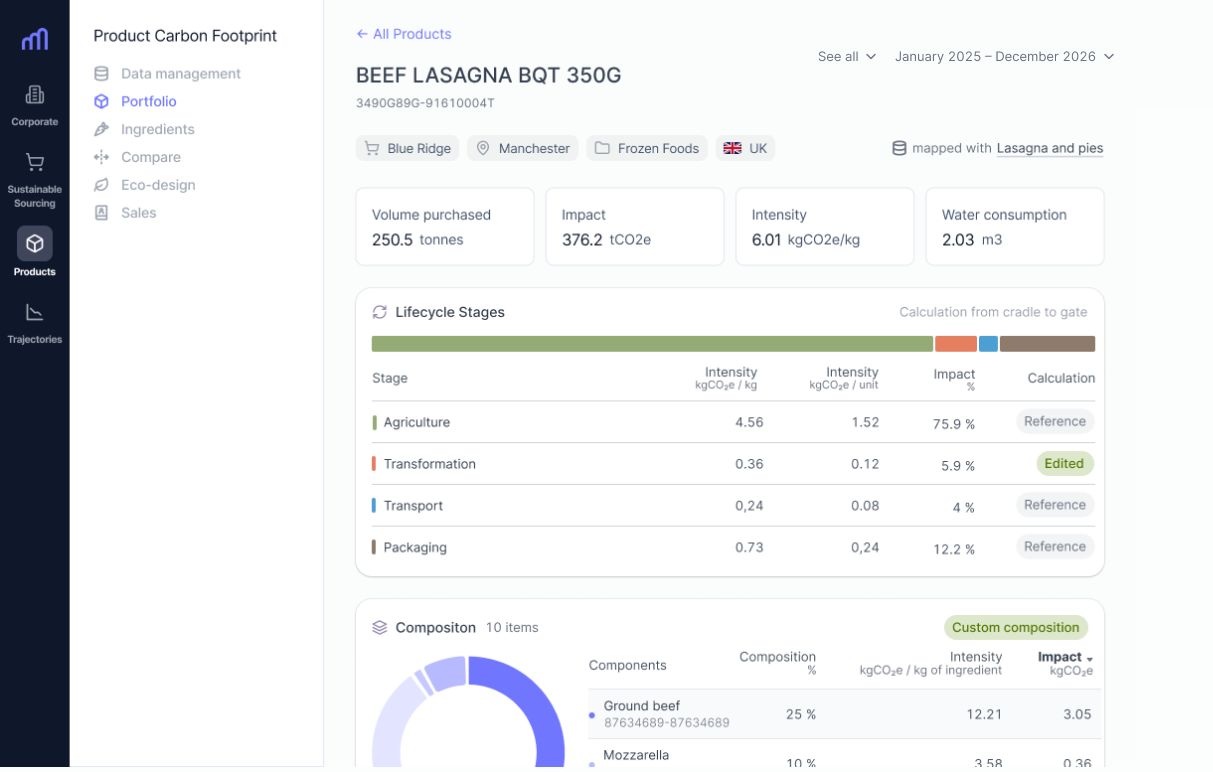
Carbon Maps generates granular Product Carbon Footprints across your entire portfolio from the data you already have today.
the challenge

Agriculture drives up to 90% of a
food product's footprint and
sits in the data
you don't control.

Food industry emissions aren't hiding in your factories. They're distributed across thousands of farms, suppliers, and
ingredients. Most of them upstream, outside your
operational boundary, and invisible in traditional ERP data.
Running a credible PCF program means modeling that
complexity at scale, with methodology that auditors accept
and business leaders can act on.
90%
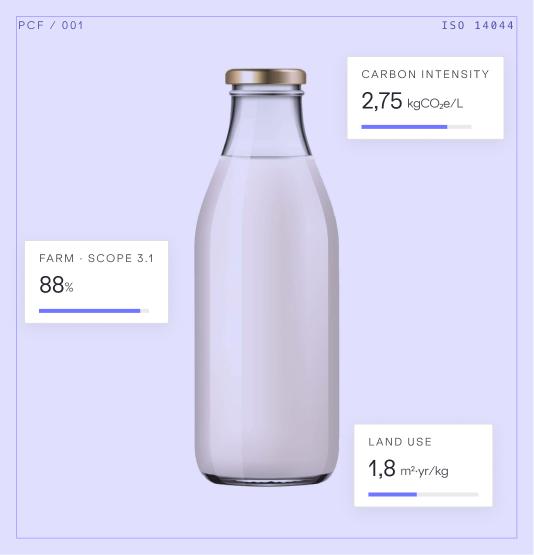
of food-industry emissions sit in upstream operations within Scope 3
34k+
emission factors referenced across our agricultural database
6-12mo
typical time to first PCF with legacy
LCA tools
0data gaps blocking day 1
Carbon Maps runs on the data you
already have, refines as it grows
Why Carbon Maps

Built for the
hardest part of PCF: agriculture.

Generic LCA tools weren't designed for food supply chains.
Three decisions make Carbon Maps different and let our
customers ship PCFs where others are still onboarding.
01 - Built for agriculture
Agricultural
expertise, built in.
Supply chains rooted in agriculture are among the most complex to model: long, opaque, and highly variable. Carbon Maps is purpose-built for this reality, with emission factors, methodologies, and data models that reflect the true complexity of food and agriculture supply chains.
01 - Built for agriculture
Agricultural
expertise, built in.
Most tools require extensive datacollection before they can deliver anythinguseful. Carbon Maps is designed togenerate granular PCFs from the minimumviable data and improve automaticallyas your supply chain data matures.
01 - Built for agriculture
Agricultural
expertise, built in.
Carbon is only part of the picture. CarbonMaps calculates full life cycle assessments, covering water use, land use, biodiversity impact, and more, so yourenvironmental reporting goes deeper thanyour competitors' without addingcomplexity for your team.
The platform

Four things your PCF
program
needs to get right.

Feature 01 · Compliant
Meet the standards
your stakeholders
already require.
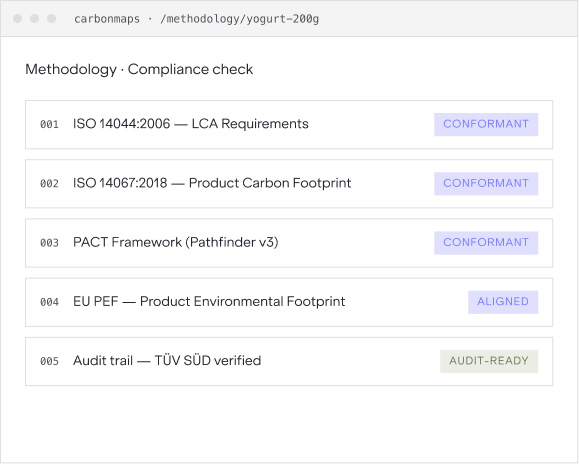
Carbon Maps PCFs are fully aligned with ISO 14044, PACT
and PEF methodologies — the frameworks your customers,
retailers, and suppliers are converging on. Every calculation
is audit-ready and comparable, so your disclosures hold up
to scrutiny wherever they land.
ISO 14040 / 14044 / 14067
PACT (Pathfinder) conformant
EU PEF methodology
Third-party auditable trails
Feature 02 · coherent
Every update,
reflected across
your entire portfolio.
Carbon Maps PCFs are fully aligned with ISO 14044, PACT
and PEF methodologies — the frameworks your customers,
retailers, and suppliers are converging on. Every calculation
is audit-ready and comparable, so your disclosures hold up
to scrutiny wherever they land.
ISO 14040 / 14044 / 14067
EU PEF methodology
Third-party auditable trails
Feature 03 · ComplETE
Meet the standards
your stakeholders
already require.
Carbon Maps PCFs are fully aligned with ISO 14044, PACT
and PEF methodologies — the frameworks your customers,
retailers, and suppliers are converging on. Every calculation
is audit-ready and comparable, so your disclosures hold up
to scrutiny wherever they land.
ISO 14040 / 14044 / 14067
PACT (Pathfinder) conformant
EU PEF methodology
Feature 04 · AI-driven
From ingredients to
emission factors,
automatically.
Manually matching thousands of ingredients and materials
to the right emission factors is where PCF programs
typically break down. Carbon Maps uses AI to do this
automatically, cutting the time and cost of building and
maintaining PCFs at scale.
Automated ingredient matching
Confidence scoring on every match
Human-in-the-loop review queue
What our customers say

Built with the teams
already shipping
PCFs at scale.

"
Beyond the platform itself, their team
helped structure our data and provided
a rigorous, actionable methodology
while adapting to the specificities of
our products.
Florian Trohay
Deputy Director of Sustainability · Sodiaal
"
Beyond the platform itself, their team
helped structure our data and provided
a rigorous, actionable methodology
while adapting to the specificities of
our products.
FT
Florian Trohay
Deputy Director of Sustainability · Sodiaal
Trust & compliance

Disclosures
that hold up
to scrutiny.

PACT
Pathfinder Framework v3
— the cross-industry
standard for exchanging
product carbon data.
PACT Conformant
PACT
Pathfinder Framework v3
— the cross-industry
standard for exchanging
product carbon data.
PACT Conformant
PACT
Pathfinder Framework v3
— the cross-industry
standard for exchanging
product carbon data.
PACT Conformant
The full platform

Three more
solutions, one
source of truth.

Corporate
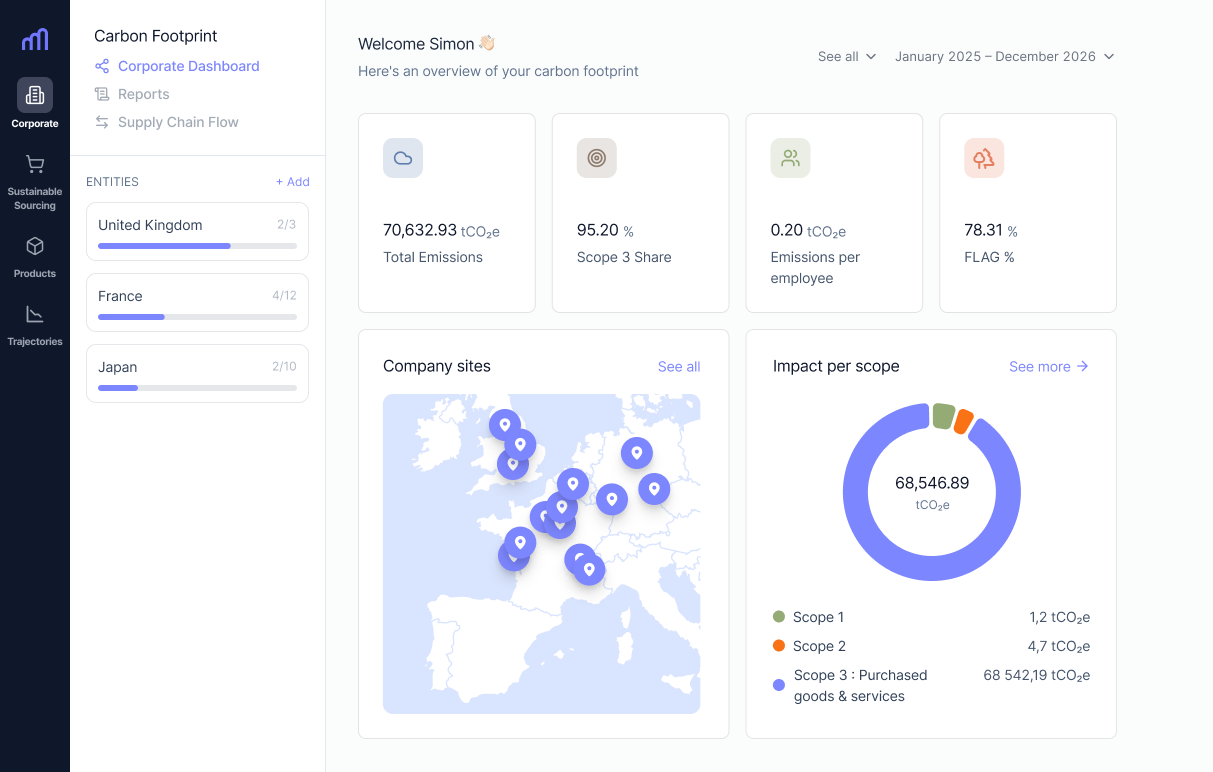
Corporate Carbon Footprint
Scope 1, 2 and 3 assessment aligned with the
GHG Protocol — powered by the same
product-level granularity.
Explore
Corporate
Corporate Carbon Footprint
Beyond the platform itself, their team
helped structure our data and provided
a rigorous, actionable methodology
while adapting to the specificities of
our products.
Explore
Corporate
Corporate Carbon Footprint
Scope 1, 2 and 3 assessment aligned with the
GHG Protocol — powered by the same
product-level granularity.
Explore
Questions & answers

Everything you
need to know
about PCFs.

Still have questions? Our team can walk you through the
methodology, data flow, and deployment plan in a 30-minute
working session.
What is LCA in the food industry?
+
A Life Cycle Assessment (LCA) measures the full environmental impact of afood product from cradle to grave — including farming practices, production,packaging, transport, consumption, and end-of-life. It covers multipleindicators such as carbon emissions, water use, and land use. A ProductCarbon Footprint (PCF) is a specific outcome of an LCA, focusing only ongreenhouse gas emissions (CO₂e). It's particularly useful for climate reporting,supply chain engagement, and setting science-based targets. In short: everyPCF is based on LCA methodology.
How can food companies scale LCAs and PCFs across large product portfolios?
+
A Life Cycle Assessment (LCA) measures the full environmental impact of afood product from cradle to grave — including farming practices, production,packaging, transport, consumption, and end-of-life. It covers multipleindicators such as carbon emissions, water use, and land use. A ProductCarbon Footprint (PCF) is a specific outcome of an LCA, focusing only ongreenhouse gas emissions (CO₂e). It's particularly useful for climate reporting,supply chain engagement, and setting science-based targets. In short: everyPCF is based on LCA methodology.
What makes Carbon Maps different from other LCA or PCF tools?
+
A Life Cycle Assessment (LCA) measures the full environmental impact of afood product from cradle to grave — including farming practices, production,packaging, transport, consumption, and end-of-life. It covers multipleindicators such as carbon emissions, water use, and land use. A ProductCarbon Footprint (PCF) is a specific outcome of an LCA, focusing only ongreenhouse gas emissions (CO₂e). It's particularly useful for climate reporting,supply chain engagement, and setting science-based targets. In short: everyPCF is based on LCA methodology.
Can I use Carbon Maps without complete supplier data?
+
A Life Cycle Assessment (LCA) measures the full environmental impact of afood product from cradle to grave — including farming practices, production,packaging, transport, consumption, and end-of-life. It covers multipleindicators such as carbon emissions, water use, and land use. A ProductCarbon Footprint (PCF) is a specific outcome of an LCA, focusing only ongreenhouse gas emissions (CO₂e). It's particularly useful for climate reporting,supply chain engagement, and setting science-based targets. In short: everyPCF is based on LCA methodology.